Tracklist 15 tracks · 1 h 10 min
- 1 Bez ograniczeń energii S. Łosowski, arr. K. Lenczowski 3:55
- 2 Funky dla Franki J. Grzywacz, arr. M. Smoczyński 3:25
- 3 Basia M. Urbaniak, arr. K. Lenczowski 4:50
- 4 Nasty Gal J. Lee, z repertuaru Z. Seiferta, arr. M. Zaborski 6:40
- 5 Kujaviak Goes Funky Z. Namysłowski, arr. K. Lenczowski 6:23
- 6 Coś specjalnego B. Kawka, arr. K. Lenczowski 5:00
- 7 Sprzedaż glonów J. Ptaszyn Wróblewski, arr. M. Smoczyński 4:44
- 8 Tiritaka K. Dębski, arr. K. Lenczowski 3:13
- 9 Winobranie Z. Namysłowski, arr. M. Smoczyński 7:16
- 10 Torpedo B. Kawka, arr. D. Lubowicz 2:56
- 11 Taniec Maryny J. Śmietana, W. Sendecki, arr. D. Lubowicz 4:39
- 12 Jak na lotni W. Świergiel, arr. D. Lubowicz 4:44
- 13 Body Rub M. Urbaniak, arr. M. Smoczyński 4:30
- 14 Funky dla pani Hanki J. Muniak, arr. K. Lenczowski 4:33
- 15 Ale wkoło jest wesoło Z. Hołdys, arr. D. Lubowicz 3:53
About the album
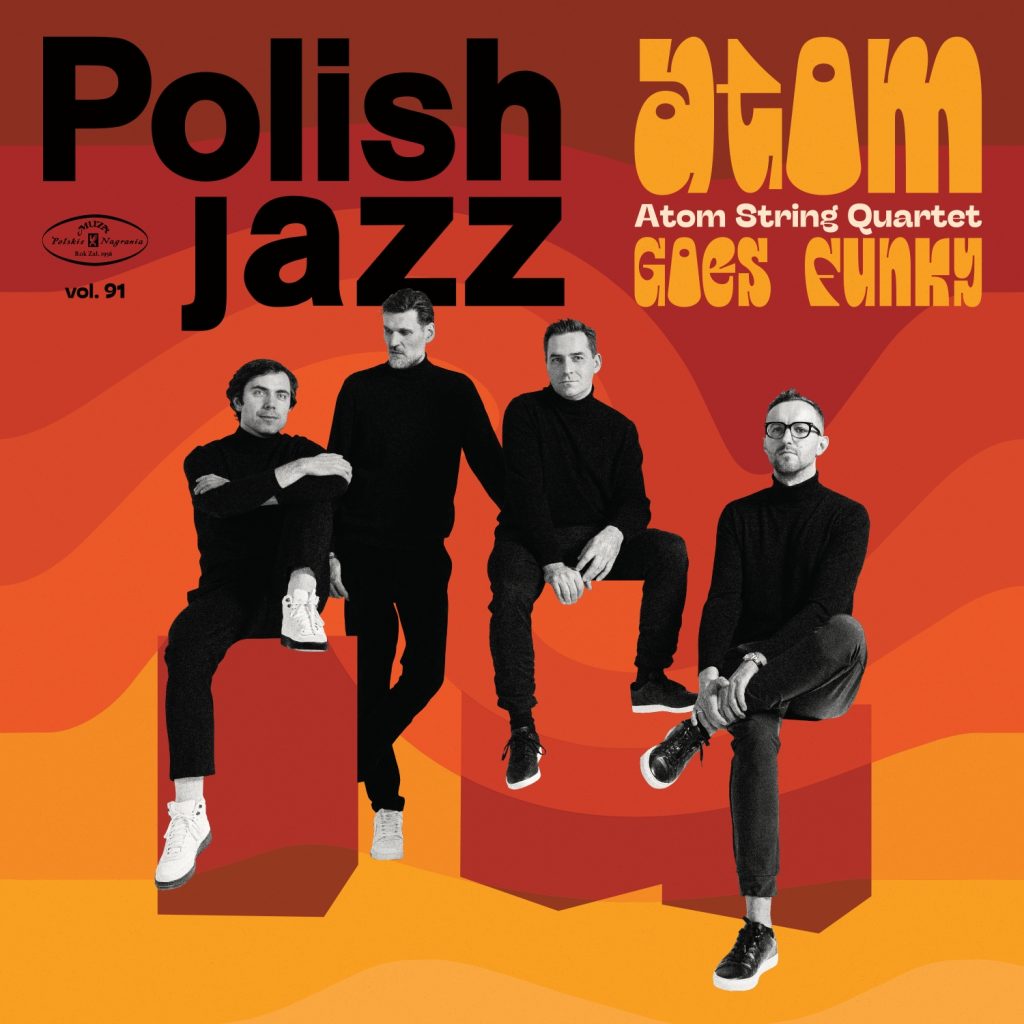
This is, in a sense, a return to the roots. Atom String Quartet began with funk, playing its own compositions in that style. Today Dawid Lubowicz, Mateusz Smoczyński, Michał Zaborski and Krzysztof Lenczowski reach for the funk tunes they listened to when young, at home, on vinyl records with colourful covers — often bearing the Polish Jazz logo. In paying tribute to that glorious chapter of Polish recorded music, they write a chapter of their own: "Atom Goes Funky" is the 91st album in the Polish Jazz series, and the first ever recorded by a string quartet.
Funk on a string quartet? That takes courage. Instrumentation, after all, plays a large part in funk: bass, electric guitar, horns, keyboards, drums... How does one translate that into a quartet? The first step is to dig the structure of a composition out from under its funk colours. And here come the surprises: Zbigniew Namysłowski's cult "Kujaviak Goes Funky" (Polish Jazz vol. 46) and Extra Ball's "Taniec Maryny" (Polish Jazz vol. 48) take on a folk blush. "Coś specjalnego" without Novi Singers reveals its swing character, and "Jak na lotni" without Andrzej Zaucha its cabaret one. So the ASQ musicians go further and restore the funk colour — using nothing but their own instruments. There are no loopers here, no delays, no pickups altering the tone... Four instruments are enough, in the hands of musicians who know how to translate the language of funk onto them. Bass? Cello lines, sometimes arco, sometimes pizzicato, sometimes with an expressive slap of the strings, a quasi-guitar strum. Drums? Four resonant bodies give a round, deep, carrying sound. Guitars? Violin chops — short, hard-bowed phrases underlining the rhythm — do the job perfectly. Horn section? Violin-and-viola riffs imitate it splendidly. It works even in a piece as unlikely as Namysłowski's "Winobranie 72" (Polish Jazz vol. 33): a 7/8 metre, "our" highland Lydian scale — and still the ASQ version draws out elements that leave no room for doubt. This is funk!
There is one more thing: the recording and production, the work of Michał Bereza. The customary way of recording a string quartet — in the distant, wide perspective of a concert hall — would have drowned the Atom groove in reverb. So the music is recorded here close up, dry and crystalline. Choosing the right microphones reportedly took a whole day. It was worth it. Bereza deftly avoided the glassy scrape that close miking threatens, achieving a full yet selective sound for the quartet's instruments. The placement is unconventional: the "bass" cello and the melody-leading violin sit at the centre of the stage, while the viola and the second violin — filling, conversing, driving the pieces forward with cutting chops — are spread to the sides. How good it sounds!
The compositions? There had to be pieces that make funk promises in their titles and keep them with interest. "Funky dla Franki" by Janusz Grzywacz and Laboratorium (Polish Jazz vol. 49), "Funky dla pani Hanki" by Janusz Muniak ("Placebo") and Namysłowski's aforementioned "Kujaviak Goes Funky" are models of funk: a driving character, accents on the one followed by intricate syncopations that create the groove, and above all a prominent, riffing bass part — more important even than the drums. That is how "Sprzedaż glonów" by Jan Ptaszyn Wróblewski pulses, and how Bernard Kawka's compositions from the Novi Singers repertoire ("Coś specjalnego", "Torpedo") get funky. No different are the pieces from the repertoires of jazz violinists: Zbigniew Seifert (John Lee's "Nasty Gal", which he used to play), Krzesimir Dębski ("Tiritaka", Polish Jazz vol. 62) or Michał Urbaniak's "Body Rub", with the sound of the baritone violin. One can hear, too, that 1970s funk inspired Urbaniak's "Basia" (1996), as well as the rock bands of the 1980s: the hit "Bez ograniczeń energii" by Sławomir Łosowski and Kombi (the memorable theme of the children's programme "5-10-15"), and Perfect's rather unexpected — though in the ASQ version simply funky — "Ale wkoło jest wesoło".
Note that one of the tracks begins with vinyl hiss, crackles and pops, out of which the delicate sounds of the music emerge... That is "Coś specjalnego", in an arrangement kept in the middle register so characteristic of old LPs. A wonderful device: close your eyes and the climate of those years returns — the mood, the images, the flares, the turtlenecks, the long hair, the colourful jackets; you are carried away... "...once upon a time in Hollywood", Tarantino once proposed. Atom String Quartet has another idea: "Once upon a time in Warsaw". It carries us back to the 1970s, to the pieces that lit up the greyness of those days. To sounds that betrayed a fascination with everything Western, fashionable and modern. To music that has kept its power to colour — to this day. "Polish Jazz" and Polish funk are doing fine. Here and now.
Mariusz Gradowski
Video1
More from this artist12